
These picks are chosen for outdoor use specifically: brightness that holds up in less-than-perfect darkness, battery life or power flexibility that works away from a wall outlet, built-in streaming that doesn't require a laptop or extra device, and audio that's at least functional for a small group. Here's what actually works outside.
1. Anker Nebula Capsule 3 Laser
Best overall portable outdoor projector
The Capsule 3 Laser is the most impressive compact projector on this list. It fits in a large coffee mug, delivers 300 ISO lumens (which reads brighter than many 500-lumen lamp-based projectors), and runs Google TV natively – meaning Netflix, Disney+, Prime Video, YouTube, and everything else is available directly without a streaming stick. The laser light source produces a sharp, colorful image that holds up noticeably better in low-light outdoor conditions than lamp-based projectors at similar price points.
Battery life runs around 2.5 hours in standard mode, which covers most films. The built-in speaker is genuinely good for its size – loud enough for a small group in a quiet outdoor setting, though you'll want a Bluetooth speaker for anything larger. The auto-focus and auto-keystone features work reliably, which matters outdoors where you're rarely setting the projector on a perfectly level surface.
The limitation is the price – it sits in the $500–$550 range, which is not a casual purchase. But if you want a single device that does everything without accessories and is genuinely portable enough to take camping or to a friend's yard, nothing in its size category competes with it.
Brightness: 300 ISO lumens (laser)
Battery life: ~2.5 hours
Built-in streaming: Google TV
Native resolution: 1080p
Best for: Travelers, campers, backyard setups, and anyone who wants all-in-one convenience
2. XGIMI Halo+
Best for image quality in a portable form
The XGIMI Halo+ is a step up in image quality from the Capsule 3 Laser, with 900 ISO lumens that make it one of the brightest genuinely portable projectors available. That brightness matters outdoors more than almost any other spec – it gives you a usable image even when the sky isn't fully dark yet and holds up better when ambient light from neighbors or streetlights is a factor.
It runs Android TV (not Google TV, but the practical difference is minor), supports Chromecast built-in, and has automatic keystone correction and autofocus that work well on irregular surfaces. The built-in Harman Kardon speakers are the best audio of any portable projector on this list – genuinely usable for groups of 5–8 people in a quiet outdoor setting, though you'll still want external audio for larger gatherings.
The tradeoff is size – the Halo+ is larger and heavier than the Capsule (roughly the size of a 1.5 liter bottle), which makes it less backpack-friendly but still easily carried in a bag. Battery life runs 2–3 hours. The price is typically $600–$650, which positions it as a premium option, but the brightness improvement over cheaper projectors is legitimately noticeable outdoors.
Brightness: 900 ISO lumens
Battery life: ~2.5 hours
Built-in streaming: Android TV with Chromecast
Native resolution: 1080p
Best for: Backyard movie nights where image quality and brightness are the priority
3. Dangbei Atom
Best value for outdoor brightness
The Dangbei Atom punches significantly above its price point. At around $400–$450, it delivers 1,100 ANSI lumens from a laser light source, runs Google TV natively, and produces a genuinely sharp 1080p image. That brightness-to-price ratio is better than anything else on this list, and for outdoor use where lumens are the most important single spec, that matters.
It's slightly larger than the XGIMI Halo+ and doesn't have a built-in battery – you'll need a power outlet or a portable power station to run it outdoors. That's the meaningful limitation versus fully battery-powered options. But if you're setting up in a backyard with access to an extension cord, the Atom gives you significantly more brightness for less money than the competition. The auto-focus and auto-keystone work reliably, and the Google TV interface is clean and responsive.
Audio is where it's weakest relative to the XGIMI – the built-in speakers are functional but thin, and you'll want a Bluetooth speaker for any outdoor gathering. Set that expectation going in and it's easy to work around.
Brightness: 1,100 ANSI lumens (laser)
Battery life: None – requires power outlet or power station
Built-in streaming: Google TV
Native resolution: 1080p
Best for: Backyard setups with power access where brightness matters most and budget is a consideration
4. Anker Nebula Solar Portable
Best budget pick with battery
If you want a solid battery-powered projector for outdoor use without spending $500+, the Nebula Solar Portable is the most reliable option at its price point (around $300–$350). It delivers 400 ANSI lumens – not stunning, but workable in full dark conditions – and runs Android TV with the full Google Play app ecosystem. Battery life runs 3–4 hours, giving you more than enough for a full film without worrying about power.
The autofocus works well and the image is sharp for its class. The built-in speaker handles small groups in quiet outdoor settings. This is not a projector that will impress you with its brightness if there's any ambient light present – start it in full dark and it performs; try to run it before the sun is fully down and you'll be disappointed. Work within its limitations and it's a genuinely good value for what it costs.
Brightness: 400 ANSI lumens
Battery life: ~3.5 hours
Built-in streaming: Android TV
Native resolution: 1080p
Best for: Casual backyard use, camping, and anyone who wants battery-powered portability without spending $500+
5. Samsung Freestyle 2nd Gen
Best for design and smart TV features
The Samsung Freestyle is genuinely different from everything else on this list – it's designed to be pointed at any flat surface, including walls and ceilings, without any manual adjustment. The auto-leveling, auto-keystone, and auto-focus work together so that you point it at a surface, turn it on, and it configures itself. For outdoor use, that means pointing it at a garage wall, a fence, or a bedsheet and having a usable image almost instantly.
It runs Samsung's Tizen smart TV platform with full access to Netflix, Disney+, Prime Video, and the rest. Brightness is 550 ISO lumens from an LED light source – not the strongest on this list but adequate in full dark. Battery life is around 3 hours. The 360-degree bottom speaker is surprisingly good for a compact projector. The form factor – it looks like a studio light on a small base – is uniquely practical for setting up quickly in unusual locations.
The limitation is price ($700–$800 for the second generation) and the relatively modest brightness compared to the XGIMI Halo+ at similar money. You're paying partly for the design and ease of use. If quick setup and flexibility matter more than maximum brightness, it's worth it. If you're prioritizing raw image performance, the XGIMI is a better choice for the money.
Brightness: 550 ISO lumens
Battery life: ~3 hours
Built-in streaming: Tizen (Samsung Smart TV)
Native resolution: 1080p
Best for: Users who want instant, no-fuss setup and are willing to pay for it
6. Viewsonic M2e
Best for laptop-free streaming with simple setup
The Viewsonic M2e is the most straightforward pick for someone who wants plug-and-play outdoor streaming without a lot of configuration. It runs Harman audio, supports Bluetooth streaming directly from a phone or tablet, and has a clean Aptoide app interface that handles most major streaming services. Setup is faster than most projectors because there's less to configure.
Brightness is 1,000 ANSI lumens, which is strong for its size class, and it runs on battery for around 3 hours. The autofocus works reliably and the throw angle is flexible. The limitation is that the software interface is less polished than Google TV or Samsung's Tizen, and app availability is more limited than a full Android TV device. For Netflix in particular, you'll need to use the Nebula Connect app or sideload, which is a step that puts some users off.
If you're comfortable with minor workarounds and want a bright, battery-powered outdoor projector at around $400, the M2e is a solid choice. If Netflix compatibility needs to be completely seamless, look at the Nebula Capsule 3 or XGIMI Halo+ instead.
Brightness: 1,000 ANSI lumens
Battery life: ~3 hours
Built-in streaming: Aptoide (with some limitations)
Native resolution: 1080p
Best for: Versatile outdoor use where brightness and battery life are priorities
What to Look for in an Outdoor Projector
Lumens above everything. For outdoor use, brightness is the most important spec. Anything below 400 ANSI lumens needs full dark to produce an acceptable image. 500–900 is the workable range for typical backyard conditions. 1,000+ gives you flexibility when conditions aren't perfect. Note that "ISO lumens" and "ANSI lumens" are measured differently – ISO lumens tend to read slightly higher than ANSI lumens for similar actual brightness.
Built-in streaming vs. HDMI input. Projectors with Android TV or Google TV built in are significantly more convenient for outdoor use than ones that require an external streaming stick. The fewer cables and extra devices, the easier outdoor setup becomes.
Battery life or power flexibility. A projector that runs 2.5–3.5 hours covers most films. If you want to do double features or longer watch sessions, bring a portable power station as backup. Projectors that can run from a USB-C power bank (some compact models support this) offer the most flexibility.
Auto-keystone and autofocus. Outdoors, you're rarely setting the projector on a perfectly flat, perfectly aligned surface. Automatic keystone correction and autofocus eliminate the need to manually tweak the image every time you move or reposition.
Audio. Built-in speakers on portable projectors range from surprisingly good (XGIMI Halo+, Samsung Freestyle) to functional-but-thin. Plan for a Bluetooth speaker in any outdoor setup and treat built-in audio as a convenience backup rather than the primary sound system.
Common Mistakes to Avoid
Buying based on lumen claims without checking measurement standards. A projector advertised at "6,000 lumens" from a budget brand is not equivalent to 400 ANSI lumens from a calibrated manufacturer. Look for ANSI lumens or ISO lumens figures from established brands, and be skeptical of very high numbers at low prices.
Assuming the built-in battery is enough without testing. Projector batteries degrade with use and don't always hit their rated capacity in real-world conditions. Test your projector's actual battery life with the brightness setting you'll use outdoors before your first event.
Not checking Netflix compatibility before buying. Netflix has strict HDCP requirements that block playback on some projectors when connected via certain cables or adapters. The safest approach is to use a projector with Google TV built in, or connect a Fire Stick or Roku Stick via HDMI.
Starting the film before full dark. Even a 1,000-lumen projector looks significantly better in complete dark than in the 30 minutes after sunset. Waiting for full dark is free and makes a larger difference than upgrading your projector.
FAQ
What's the minimum brightness for outdoor use? 400 ANSI lumens in complete dark is workable. For conditions that aren't perfectly dark – some ambient light from houses, streetlights, or a moon – you want at least 700–1,000 ANSI lumens. More is always better for outdoor use.
Can I use any of these projectors to stream Netflix directly? The projectors with Google TV built in (Nebula Capsule 3 Laser, Dangbei Atom, Nebula Solar Portable) support Netflix through the Google TV Netflix app. Samsung Freestyle supports Netflix via the Tizen interface. XGIMI Halo+ supports Netflix through Android TV. For the Viewsonic M2e, using a connected streaming stick via HDMI is the most reliable Netflix path.
How far does the projector need to be from the screen? Most standard throw projectors need 8–12 feet of distance to produce a 100-inch image. Short-throw projectors can sit 3–5 feet away for the same image size, which is useful in confined outdoor spaces. Check the specific throw ratio in the projector's specs to calculate the distance you need for your desired screen size.
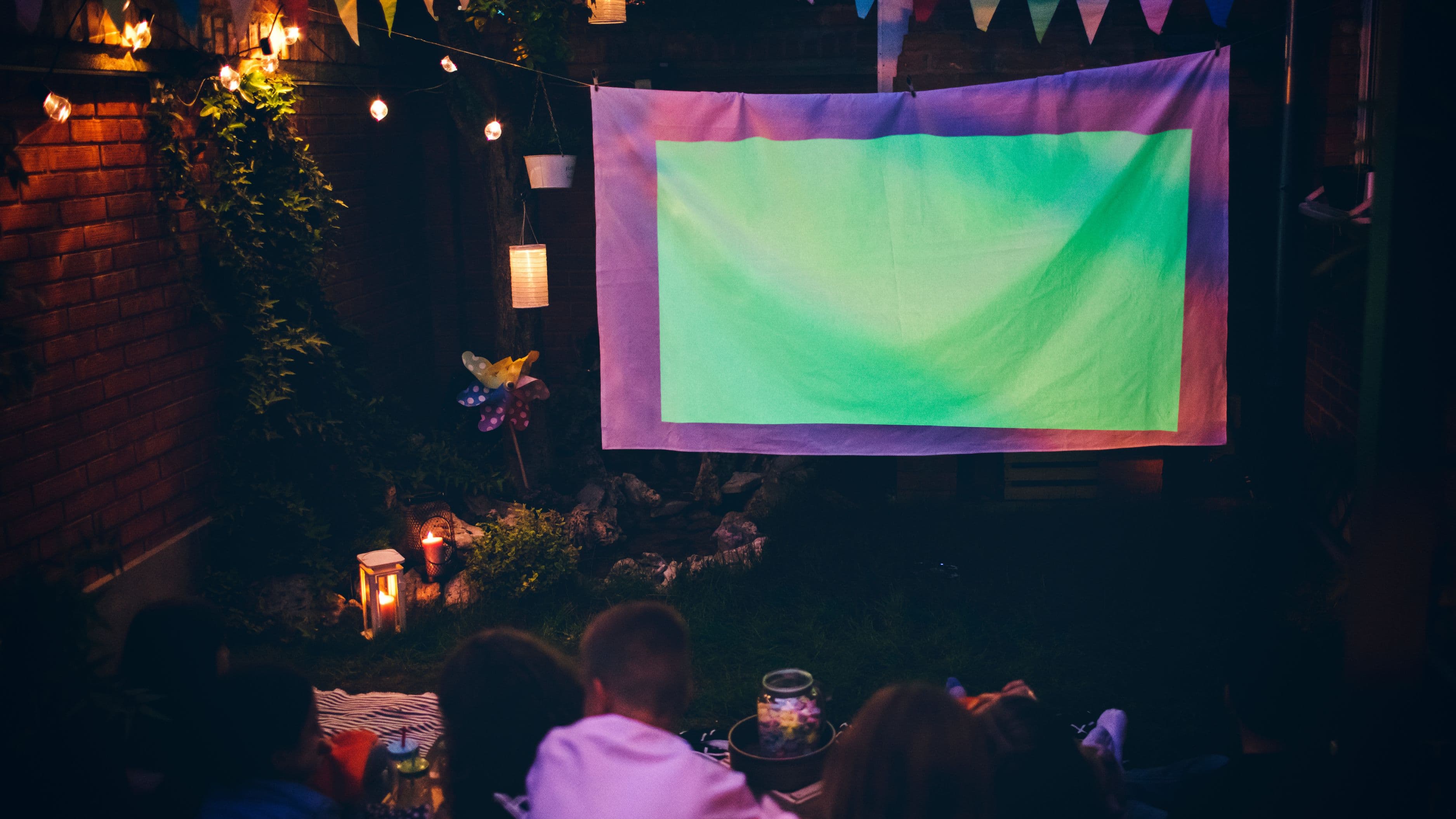
Do I need a screen or can I project onto a wall or sheet? A purpose-built projection screen gives the best image quality. A flat white or light grey wall is a good second option. A white bedsheet pulled taut works but introduces more texture and color inaccuracy. The flatter and more uniform the surface, the better the image. A wrinkled or textured surface creates visible distortion.
What portable power station should I use? For a projector drawing 50–100 watts, a 250–500Wh power station (like the Jackery Explorer 240 or Anker PowerHouse 256Wh) provides 2–4+ hours of runtime. For projectors drawing over 150 watts, step up to a 500–1,000Wh station to ensure you have enough capacity for a full film.
The outdoor projector market has improved significantly in the last two to three years, with better lumen output, more reliable smart TV software, and longer battery life across the board. Any of the options above will give you a genuinely good outdoor movie experience when used in the right conditions. Match the projector to your actual setup – your typical ambient light level, whether you have power access, and how large your typical group is – and you'll get the result you're looking for.
📚 Sources
Rtings.com – Portable projector reviews and brightness testing: https://www.rtings.com/projector/reviews/best/portable
Wirecutter/NYT – Best portable projectors: https://www.nytimes.com/wirecutter/reviews/best-portable-projector/
Anker Nebula – Capsule 3 Laser product page: https://www.seenebula.com/products/nebula-capsule-3-laser
XGIMI – Halo+ product specifications: https://us.xgimi.com/products/halo-plus
Samsung – The Freestyle 2nd Gen overview: https://www.samsung.com/us/televisions-home-theater/tvs/the-freestyle/